
Astrophysics · Cosmology · Large-Scale Structure

Pritha Paul

Postdoctoral Researcher in Cosmology

Ludwig-Maximilians-Universität München

Scroll
Portrait of Pritha Paul

I am a cosmologist studying the distribution of matter across the Universe and developing statistical tools to extract the information encoded in galaxy surveys.

I completed my PhD in Astrophysics at Queen Mary University of London and am currently a postdoctoral researcher at Ludwig-Maximilians-Universität München.

Higher order statistics in large scale structure

We are entering an era in which the largest observable scales of the Universe can be mapped with unprecedented precision. On these scales, General Relativity predicts subtle signatures in the distribution of galaxies that are missed by standard analyses. I use higher-order statistics and novel cosmological observables to identify these effects and distinguish them from primordial signals generated in the early Universe.

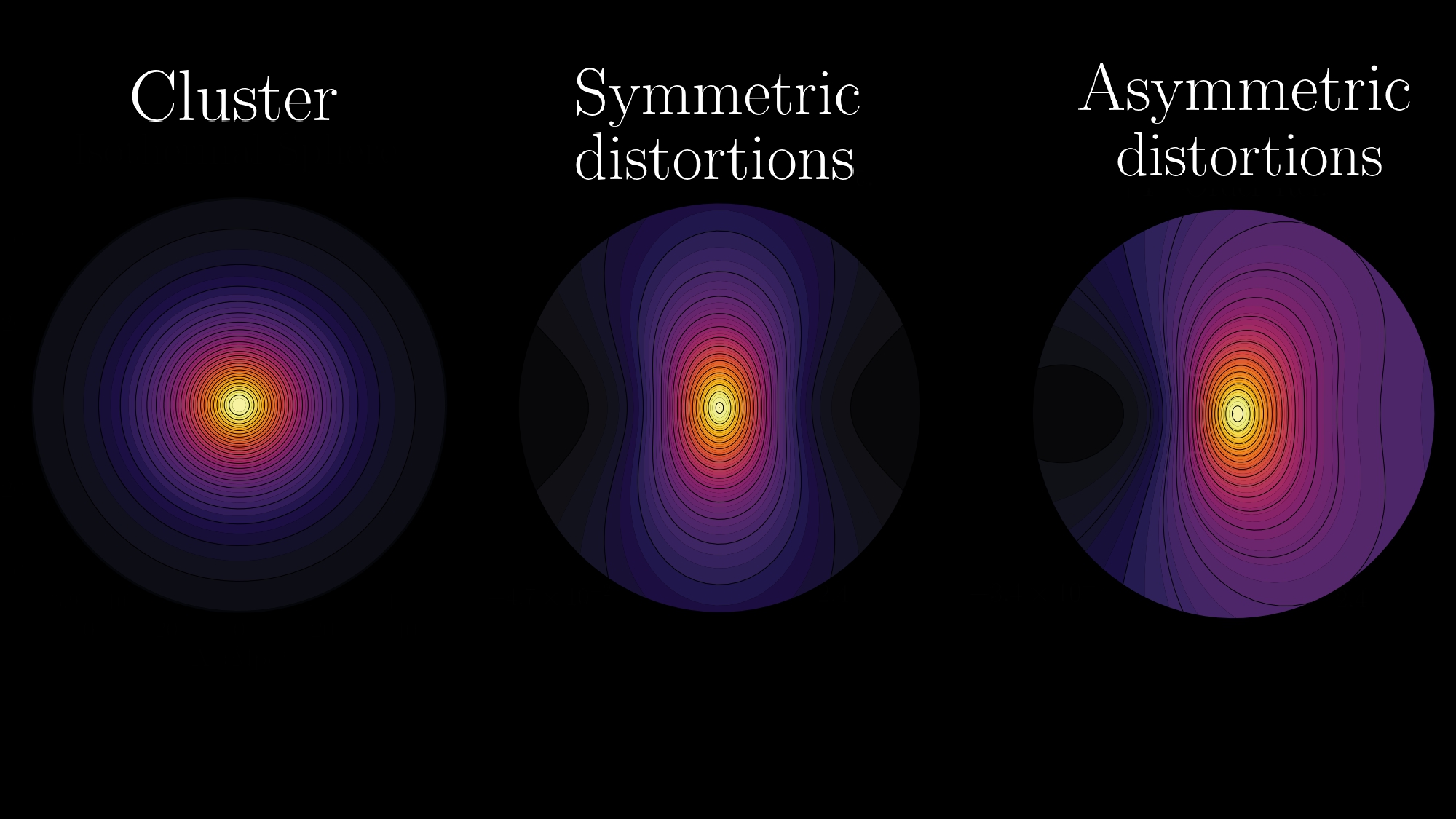
Illustration of an observed galaxy cluster distorted by Newtonian and relativistic effects

Relativistic effects in large-scale structure

Standard analyses of galaxy clustering describe the observed signal primarily through the underlying matter distribution and the effects of galaxy motions. While this captures much of the relevant physics on smaller scales, it does not provide a complete description on the largest observable scales.

There, Doppler, gravitational and other projection effects become increasingly important. These relativistic contributions alter the observed clustering pattern and can break symmetries that are present in the standard signal. I investigated these effects in the galaxy power spectrum, where this contribution generates an asymmetry between different galaxy populations.

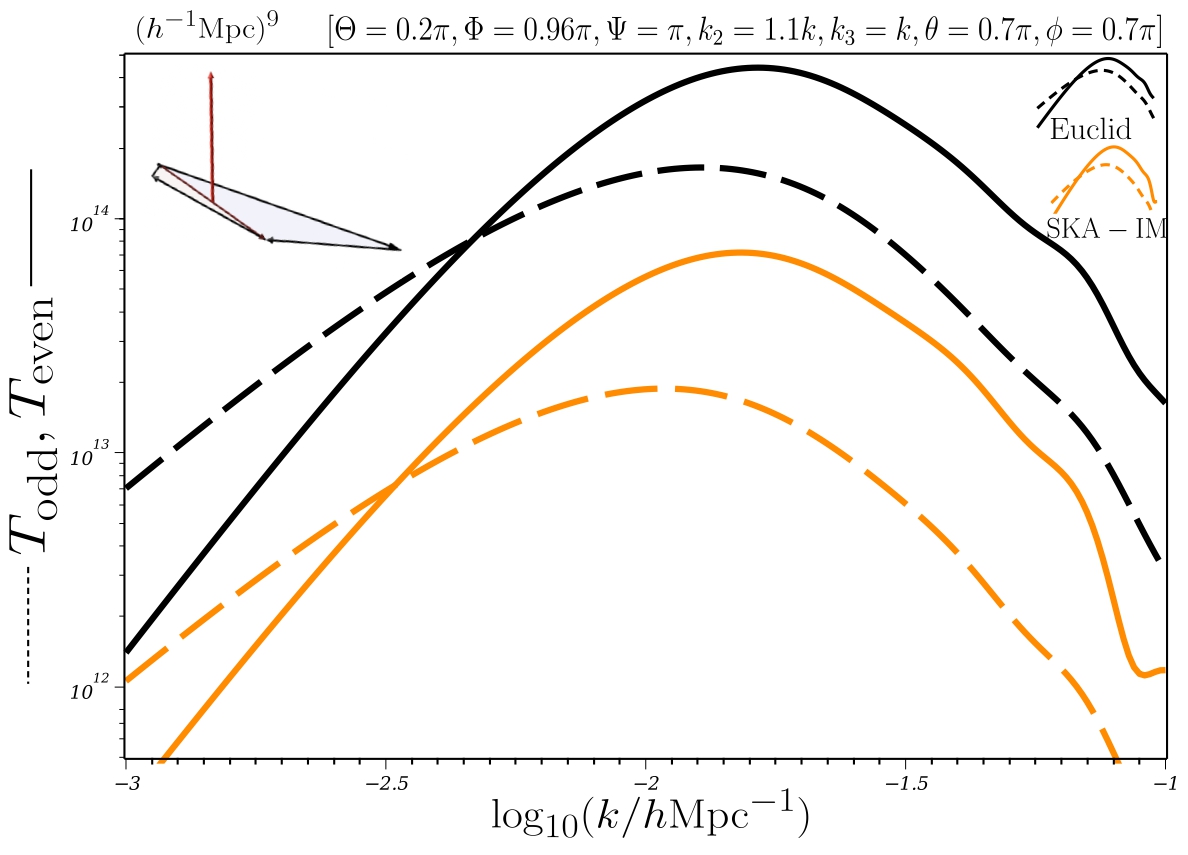
Plot showing even and odd contributions to a cosmological trispectrum

Higher-order statistics

The bispectrum and trispectrum describe correlations between three and four points in the matter distribution, allowing us to probe information that is not accessible through the two-point function alone. These higher-order statistics are particularly valuable for studying non-linear structure formation and possible signatures from the early Universe.

I study relativistic contributions to these higher-order correlations, including odd-parity and apparently parity-violating signatures generated by observational effects.

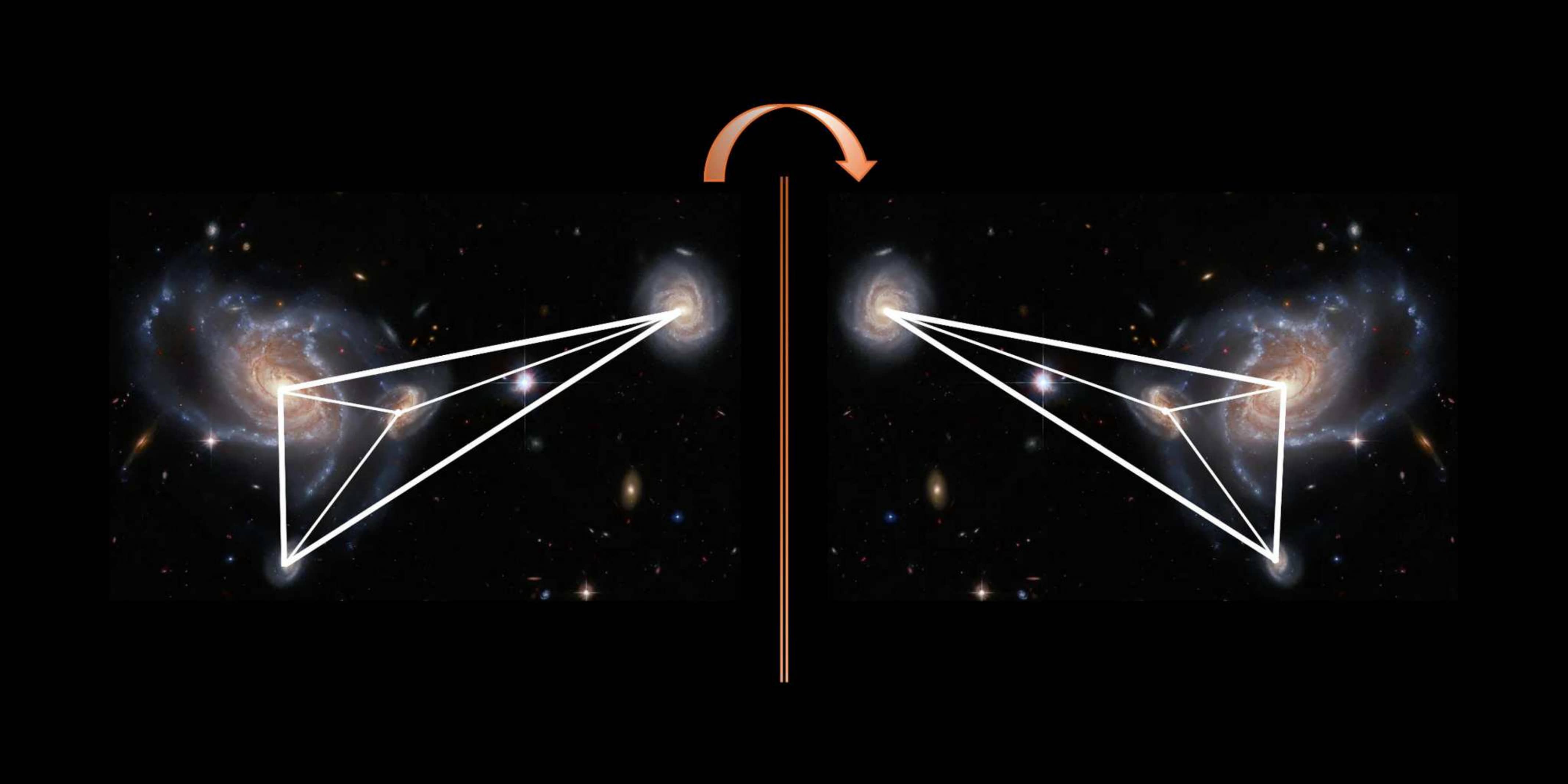
Mirrored galaxy configuration illustrating parity transformation

Parity violation on cosmological scales

I am interested in searching for signs of parity violation in cosmological observations. Detecting such a signal would reveal physics that is not captured by the standard cosmological model. By developing and studying parity-odd observables in large-scale structure and gravitational-wave backgrounds, I aim to explore whether these hidden asymmetries can provide new insights into the early Universe and the fundamental laws of physics.

Selected Publications

Research on relativistic effects, wide-angle corrections and higher-order cosmological statistics.

01

Visualising relativistic effects in redshift space distortions of large scale structure

On larger scales the motion of galaxies and the effects of gravity can subtly change how structures can appear to us. Instead of looking simply stretched or compressed, clusters, superclusters and vast empty regions called voids can appear slightly uneven or distorted along our line of sight. In this paper, we use visual examples to show how these effects can change the apparent shapes of the above structures. The aim is to make these relativistic distortions easier to understand and to illustrate how they may influence what we observe in galaxy surveys.

02

Apparent Parity Violation in the Observed Galaxy Trispectrum

We consider the galaxy trispectrum in more detail. While the intrinsic four-point correlation function, or equivalently the trispectrum, its Fourier counterpart, is parity invariant, the observed trispectrum must take redshift-space distortions into account. Although the standard Newtonian correction also respects parity invariance, we show that subleading relativistic corrections do not. We demonstrate that these can be significant at intermediate linear scales and are dominant over the Newtonian parity-invariant part on large cosmological scales.

03

Wide-angle effects in multi-tracer power spectra with Doppler corrections

We examine the computation of wide-angle corrections to the galaxy power spectrum including redshift-space distortions and relativistic Doppler corrections, and also including multiple tracers with differing clustering, magnification and evolution biases. We show that the inclusion of the relativistic Doppler contribution, as well as radial derivative terms, are crucial for a consistent wide-angle expansion for large-scale surveys, both in the single and multi-tracer cases.